Sep 6, 2015

You Know the Hood Raised You


I always score my License Plate Sticker.  

Did not do it one year, and someone borrowed the decal.


Diet That Will Work if Followed Correctly


Thanks to Richard Anderer MPHS Alumni for sharing on Facebook, shared Phil Bellefeuille's photo.


Three Scandanavians in a boat

Three men were afloat on a pile of wreckage in the midst of the North Sea – a Dane, a Norwegian, and a Swede. They were lonely, getting cold, thirsty, hungry, and almost beyond desperation after three days in the water. Their boat had fallen apart in a storm. Then suddenly one of the men spies a bottle floating nearby so they paddled their wreckage over to it. The Norwegian picks it out of the water and decides to open it.

POOF – out pops a Genie. He says, “As you know, us Genies usually give three wishes, but seeing as there are three of you, I will give each one wish. He turns to the Norwegian and says, “What is your wish?” The Norwegian doesn’t hesitate and says, “You know it’s terribly cold out here and if we don’t get back to land, we’ll all die.” "Well then,” says the Genie, “what’s your wish?” “Well," says the Norwegian, "I wish I was back home in Oslo with my wife at a dinner with a nice glass of red wine.” POOF – the Norwegian was gone, back home in Oslo with his wife at dinner and a nice glass of red wine.

The Genie turns to the Dane, “What about you?” “Well,” says the Dane, “that Norwegian was not that far off, but I wish I was back in Copenhagen in "you know what’ with my girl-friend.” POOF, the Dane was back in Copenhagen with his girl-friend.

The Genie turns to the Swede and says, “What about you?” The Swede looks a bit distressed and puzzled. He begins to ponder and think. He thinks, thinks, and does more thinking. Meanwhile the Genie waits, waits and does more waiting. Finally after nearly 30 minutes, the Genie says, “You know friend, you’ve got to make up your mind, I have only got so much time to be with you until I have to go help others. Us Genies have to get on with this ‘wish thing.’ There are many others out and about in desperate need of help, and your time is about up. If you don’t make a wish, you won’t get one. So what’s your wish?”

“Well, says the Swede. It’s terribly lonely out here without those other two guys, so I guess I wish they were back here with me.” POOF!!!


_____________


At the risk of giving Craig more to gloat about, I thought this joke, told by a Finn, was funny. It also gives you an idea of what Finns think of their Scandinavian neighbors. 

(BTW, the few native-born Finns I've met had good senses of humor.) 


-Don Martensen MPHS Jan 66

_______________________________


Gators

There was this Norwegian who was on vacation 'over-there' in Florida. All his life he'd wanted to have a pair of alligator-shoes, and now he thought he would finally be able to get around to buying a pair. 

Gator shoes are of course expensive, and haggling down the price didn't help. Finally the Norwegian yelled out in anger, In "Just keep your lousy shoes. If that's how it's going to be then I'll just get myself a boat, go out into the swamp, catch a gator and make my own shoes!" 

The owner of the store just looked stupidly at him, "Yeah, sure, and give my best regards to the Swedes who're already up there trying to do what you just told me." The Norwegian runs to a boat-rental and gets a boat, then he heads out into the swamp.
After a while he finds two Swedes standing up to their knees in the water. Both of them are holding a spear pointed at the water. That must be the Swedes the Norwegian thinks. Suddenly there's a movement in the water and an alligator swims towards one of the Swedes. The Swede is standing there like a statue, just waiting for the big gator to get closer. 

When the gator is close by the Swede sticks his spear into the gator, and with a bit of fighting he get's the beast onto the land, where there is a big pile of gators. The Swede turns the gator on his back and examines it's feet, and then finally utters, "Damn! No shoes on this one either!"



Aug 31, 2015

Dummies - Morgan Park and Beverly

Dummies - Morgan Park and Beverly


I have been puzzled for some time about references to the Rock Island Dummy Line. References to the dummy line are often found in histories of Beverly and Morgan Park, but the term is not explained.  What is now known as the Surburban line that served the communities was originally called the "dummy line".

Now, as a Mount Greenwood Hood I am happy to call my fellow alumni from Beverly/Morgan Park dummies. But I still wanted to know about the origin on the name.


The map above is part of the development map of Washington Heights in 1874, and shows the Dummy Line (aka Suburban line of the Rock Island).

Click below to see the full map

empehi.blogspot.com/2013/12/washington-heights-1874.html

_____________________________________


Wikapedia has the following about railroad "dummies".

steam dummy or dummy engine, in the United States of America and Canada, was a steam engine enclosed in a wooden box structure made to resemble a railroad passenger coach. Steam dummies had some popularity in the first decades of railroading in the U.S., from the 1830's but passed from favor after the Civil War. In Europe, locomotives of this type were described as Tram engines.

It was thought that the more familiar appearance of a coach presented by a steam dummy, as compared to a conventional engine, would be less likely to frighten horses when these trains had to operate in city streets. Later it was discovered that it was actually the noise and motion of the operating gear of a steam engine that frightened horses, rather than the unfamiliar outlines of a steam engine.


Many steam dummies were simply locomotives enclosed in coach's clothing, but some combined an actual railroad coach in the same body with the locomotive, creating an all-in-one vehicle that was a predecessor of later self-propelled railcars, usually powered by electricity or petrol.


Photos of other "Dummies"


"Nearly 80 dummy lines ran in the United States in the late 19th and early 20th centuries. Most were short lines that connected suburbs to a central city. For example, a six-mile line linked Independence and Kansas City."

"Accounts vary, but the term “dummy” apparently derived from the silencing equipment on the steam engines so as not to alarm horses. Regardless of the term’s etymology, Warrensburg’s little train was called ‘The Dummy’."
Excerpted from Dummy Line  dummyline.org

The Ridge Historical Society explains the Dummy Name as follows:

Railroad History of the Area
In the early years of the Rock Island Railroad, it saw no need to stop after Englewood until it reached Blue Island, the next real area of civilization. The scattering of farmers along this route did not warrant the necessity of stopping the trains. Produce could be taken by wagon to Chicago or Blue Island. The small population did not require the services of passenger trains. The event that changed this was the construction of the Chicago and Great Eastern Railroad in 1864. This railroad would cross the Rock Island at Vincennes Avenue and Tracy (103rd Street). A small settlement of immigrant railroad workers and farmers developed around this point. This area, known, as "The Crossing" required the trains from both railroads to stop before crossing the other's tracks. This area today is known as Washington Heights.

The Great Eastern, later called the "Pan Handle", agreed to build a small station for the accommodation of the area's residents. It was now possible to travel to downtown Chicago on the train. An additional stop was made at Upwood ( the site of Thomas Morgan's country estate at 91st and Longwood Drive). The Great Eastern provided an "accommodation" train between The Crossing and Chicago, which was essentially the first suburban commuter train to the area. Recollections of residents speak of a "dummy train" painted blue.

Dummy locomotives were a combination locomotive and passenger car housed in a body designed to disguise the steaming beast from skittish horses. The horses were rarely fooled, and the trains limited capacity, slow speed, and habit of jumping off the track hindered the growth of passenger traffic. The name was also applied to the original connection point of the Rock Island main and branch lines at 97th Street (Dummy Junction) and the branch line itself (Dummy Line). While there is no record of the Rock Island using dummy equipment, they did use small locomotives designed to run backwards and forwards. Residents may have named these diminutive locomotives "dummys" as well.


Sounds like a reasonable explanation.  But I think we Mount Greenwoodites will still refer to our Morgan Park / Beverly friends as "dummies".  


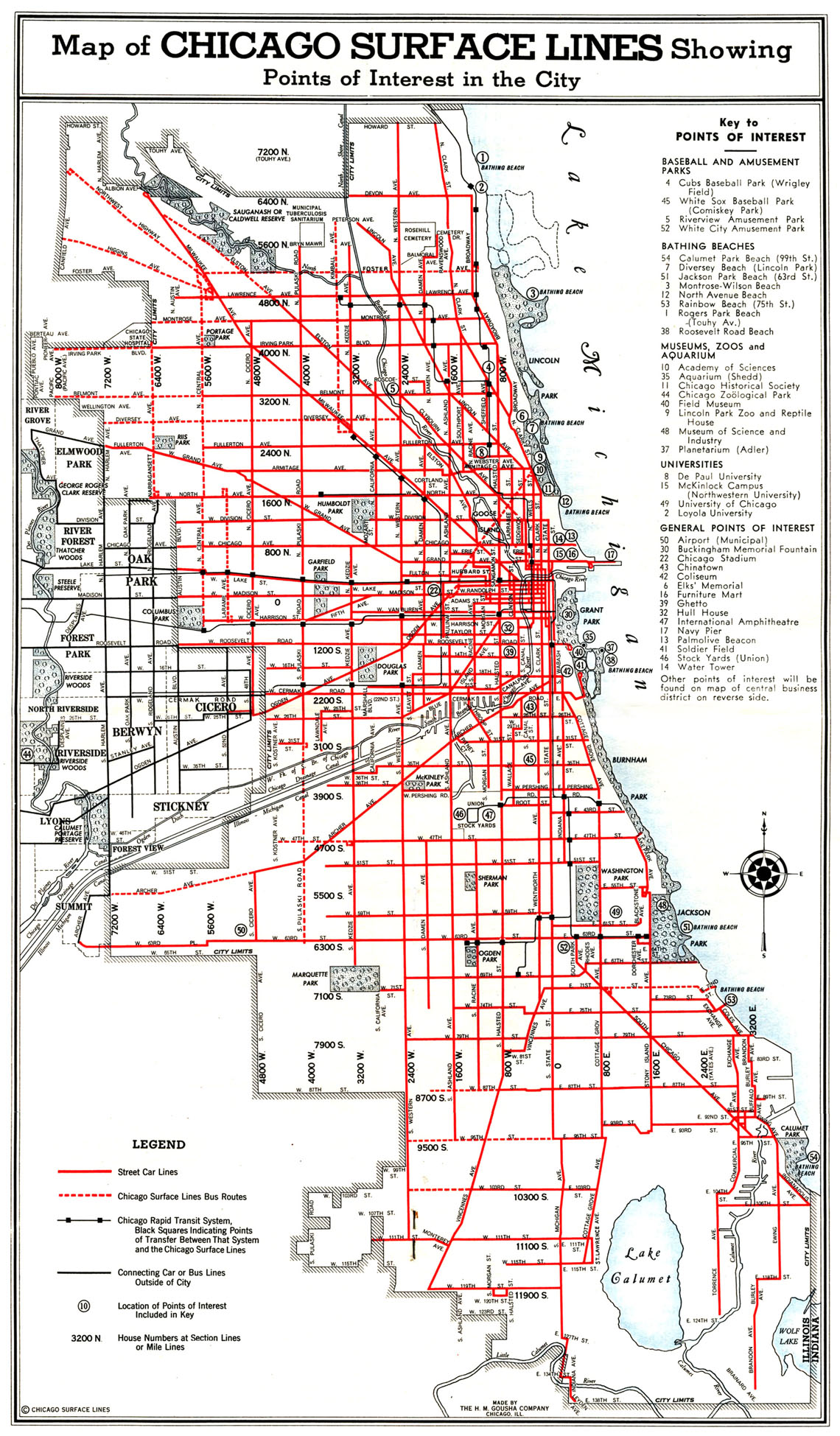
Chicago Street Cars


Click for a video 1956 to 58

youtube.com/watch?v=_q76FpiEnJo


Chicago Streetcars

CHICAGO IN MAPS


Chicago once had one of the world’s largest streetcar systems, more than 500 miles of line on nearly 100 routes by 1935. Horsecar service began in 1859, and was supplanted in the 1880s by a large network of cable car lines. In the 1890s, electric “trolleys” proved more efficient and the cable cars were replaced by 1906. Beginning in 1914, the various companies holding franchises for different parts of the city operated as a single system known as Chicago Surface Lines.
More than 3,700 large red streetcars plied the city’s streets by 1935, and 680 new streamlined green PCC cars began arriving after World War II. The new public agency Chicago Transit Authority took over the streetcar system in 1947 and began to integrate the surface lines with the city’s elevated train network. In the 1950s, CTA decided to phase out streetcars in favor of motor and electric trolley buses, and Chicago’s last streetcar ran in June 1958.
These books (both out of print) offer more details:

Lind, Alan R. Chicago Surface Lines: An Illustrated History
Johnson, James D. A Century of Chicago Streetcars
This map dates from 1937, the peak year for track mileage:


Click for more info and great maps    chicagoinmaps.com


Aug 30, 2015

If You Fall


(Too good to pass up another Share...) Ya know...... its not the fall that is the problem..... its the sudden stop. hahahhahahahahahahaha

Richard Anderer

Thanks to Richard Anderer for sharing on Facebook